
Showing posts with label Potsdam. Show all posts
Showing posts with label Potsdam. Show all posts
Saturday, May 30, 2020

Wednesday, February 6, 2019

Saturday, January 1, 2011
Still in Potsdam - Happy New Year!
In the last week I uploaded three new models to the Warehouse, all of them located in the Brandenburg capital, Potsdam.
The first two are not so far from my Stadtschloss - since they three are on the same square. The Alter Markt is the location of both the Marble Obelisk and the Church of St. Nicholas.
Uploaded on December 25, the Marmorobelisk was my small gift for Christmas. The monument was erected in 1753 by order of Frederick II, by then King in Prussia. It's on the middle of the Old Market, facing both the City Palace to the south and the Nikolaikirche to the north. Construction of the latter began in the 1830s under direction of Karl Friedrich Schinkel, who would not live to see his last work finished. After his death in 1941, his students Ludwig Persius and Friedrich August Stüler oversaw the completion of the neoclassical church, and the dome that was planned by Schinkel.
Regarding the Belvedere auf dem Klausberg, its construction was commissioned by Frederick II to Architect Georg Christian Unger (who built also the Royal Library in Berlin), and was finished in 1772. King Frederick William IV had the Belvedere as an important part of his planned Triumph Avenue that, however, was never realized. The building was to be the end of the Avenue that would have run from the Triumphtor.
The attack carried out by RAF on April 14, 1945 left the Nikolaikirche heavily damaged and the Obelisk with minor scars. The Belvedere, that escaped bombing, was shelled by the Allies by the same time and reduced to rubble, being the staircase the only recognisable remains.
Restoration of the Nikolaikirche and Marmorobelisk begun in the early 1950s, while the Belvedere had to wait until 1990, when the Stiftung Messerschmitt financed the reconstruction. When finished, it was transferred to the Prussian Palaces Foundation Berlin-Brandenburg.
The first two are not so far from my Stadtschloss - since they three are on the same square. The Alter Markt is the location of both the Marble Obelisk and the Church of St. Nicholas.
Uploaded on December 25, the Marmorobelisk was my small gift for Christmas. The monument was erected in 1753 by order of Frederick II, by then King in Prussia. It's on the middle of the Old Market, facing both the City Palace to the south and the Nikolaikirche to the north. Construction of the latter began in the 1830s under direction of Karl Friedrich Schinkel, who would not live to see his last work finished. After his death in 1941, his students Ludwig Persius and Friedrich August Stüler oversaw the completion of the neoclassical church, and the dome that was planned by Schinkel.
Regarding the Belvedere auf dem Klausberg, its construction was commissioned by Frederick II to Architect Georg Christian Unger (who built also the Royal Library in Berlin), and was finished in 1772. King Frederick William IV had the Belvedere as an important part of his planned Triumph Avenue that, however, was never realized. The building was to be the end of the Avenue that would have run from the Triumphtor.
The attack carried out by RAF on April 14, 1945 left the Nikolaikirche heavily damaged and the Obelisk with minor scars. The Belvedere, that escaped bombing, was shelled by the Allies by the same time and reduced to rubble, being the staircase the only recognisable remains.
Restoration of the Nikolaikirche and Marmorobelisk begun in the early 1950s, while the Belvedere had to wait until 1990, when the Stiftung Messerschmitt financed the reconstruction. When finished, it was transferred to the Prussian Palaces Foundation Berlin-Brandenburg.
Monday, December 20, 2010
The Potsdam City Palace, back to life
The southern part of the Alter Markt looks empty, with only the reconstructed Fortunaportal standing alone where one of the greatest Prussian palaces once stood. I'm talking about the Stadtschloss in Potsdam.
 The Potsdam City Palace was built in the 17th century for Margrave Frederick William of Brandenburg, called "The Great Elector". On the picture below, you can see how the palace looked one year after the coronation of Frederick I as King in Prussia. It soon became the winter residence of the Hohenzollern monarchs.

Frederick II of Prussia had the palace rebuilt by Georg Wenzeslaus von Knobelsdorff. The baroque became roroco, the so-called Frederician Rococo - the façades were modified, two colonnades were added, and a staircase - one of Knobelsdorff's best known works - was built in the interior. It made a unique ensemble in the Alter Markt, along with the Nikolaikirche by Schinkel and the baroque Altes Rathaus. The Stadtschloß was used as a royal residence until the fall of the German Monarchy in 1918.
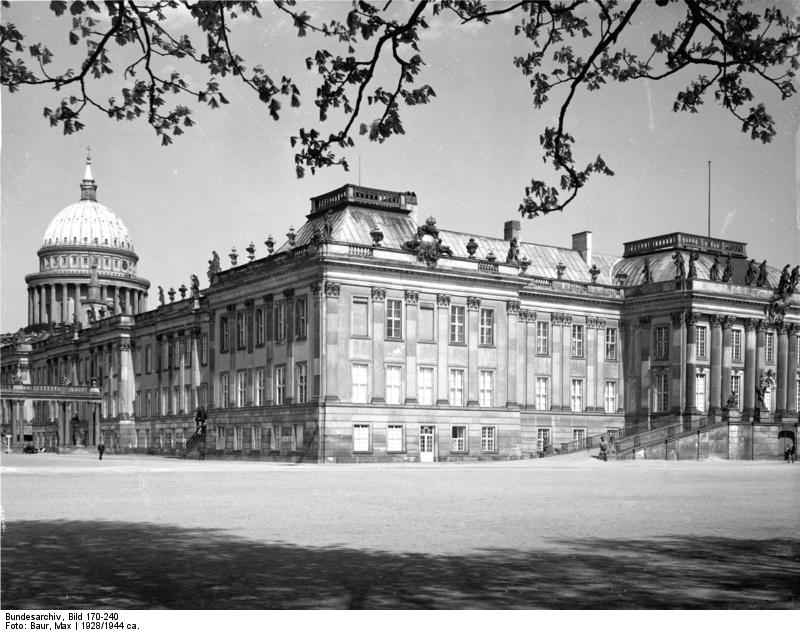
As a museum, photo taken in the 1920s.
On April 14, 1945, just two weeks before the fall of Berlin, Potsdam was bombed by RAF. The attack left scars in the Alter Markt – the destroyed dome of the Nikolaikirche, and the burnt-out palace. However, it could have been restored.
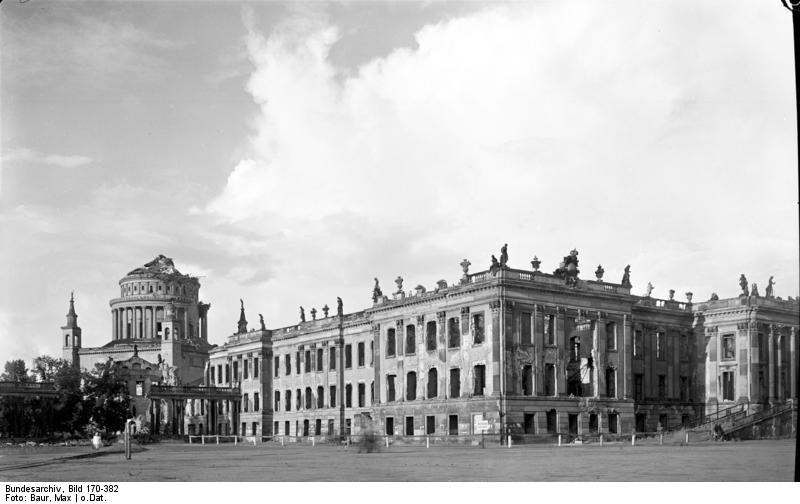
But as it was typical in the DDR, the remains of the Stadtschloß were blown up in 1950, being a “symbol of Prussian militarism” on communist eyes. Other buildings in Potsdam, including the Garrison Church and the Royal Teather, suffered a similar fate. The only existing remains are some pillars from the southern wing, the Stables (now Filmmuseum Potsdam) and part of one of the Knobelsdorff colonnades, which is now in the nearby Lustgarten.

Between 2000 and 2002, the Fortuna Gate was rebuilt on its historical position - and the Palace itself is going to be rebuilt as the seat of the Landtag of Brandenburg. While the interior will be a modern one, the facades and some inner parts of historical significance (such as the Knobelsdorff staircase) are to be rebuilt following the original layout.
Sunday, November 21, 2010
Back to Potsdam
And today I uploaded two more models, this time in Potsdam, core city of Brandenburg-Prussia, and its succesor state, the Kingdom of Prussia.
First, the Jägertor.
First, the Jägertor.
Built in 1733, the Jägertor ("Hunter's Tor") was part of the city wall that protected Potsdam by the 18th century. It was located at the northern section of the wall, where now a promenade is on its place. The section connected the Jägertor with the Nauener Tor to the East, and the (small) Brandenburg Gate to the West.


A scupture is placed at the top of the gate, showing three dogs hunting a deer as part of the typical hunting season scene.
And now, let's go with the Französische Kirche.
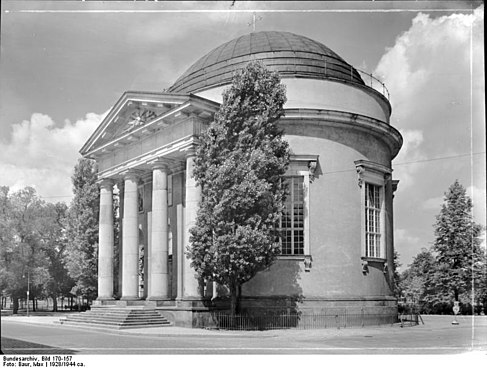
The French Church of Potsdam was built between 1752 and 1753 as a result of the Edict of Potsdam from about 70 years earlier. The religious freedom that the Kingdom offered to foreigners attracted a number of French Huguenots, expelled from their land. The Church was one of the last works by Wenzeslaus von Knobelsdorff, built by order of Frederick the Great and based in the Pantheon in Rome.
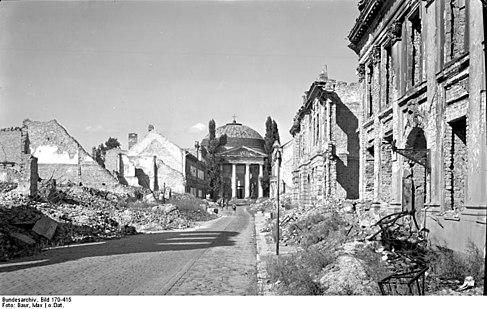
Despite several renovations and changes, the church was lucky enough to escape WWII untouched, as you can see above. Currently the Französische Kirche is the oldest church in Potsdam (the Garrison Church, built between 1730 and 1735, was demolished by the Communist regime in 1968).
Monday, September 27, 2010
Charlottenhof.
Today I have uploaded to the Warehouse another model located on Sanssouci Park: Schloss Charlottenhof.
Charlottenhof was built between 1826 and 1829 by Prussian architect Karl Friedrich Schinkel with the help of his student Ludwig Persius, by order of Crown Prince Friedrich Wilhelm (later Friedrich Wilhelm IV of Prussia, "the Romantic in the Throne"); the Kronprinz had created some designs for the project. The Palace is located on the site of a former farm house, and was built as a neoclassical villa for the Crown Prince, who used it as his summer residence.
Charlottenhof was built between 1826 and 1829 by Prussian architect Karl Friedrich Schinkel with the help of his student Ludwig Persius, by order of Crown Prince Friedrich Wilhelm (later Friedrich Wilhelm IV of Prussia, "the Romantic in the Throne"); the Kronprinz had created some designs for the project. The Palace is located on the site of a former farm house, and was built as a neoclassical villa for the Crown Prince, who used it as his summer residence.
 View in Google Earth
The furniture inside the palace was largely designed by Schinkel himself. The most dinstictive room is fashioned after a Roman Caesar's tent, decorated with blue and white patterns.
 Stained glass in Charlottenhof - detail
The Palace is maintained by the Prussian Palaces and Gardens Foundation Berlin-Brandenburg.
Thursday, July 29, 2010
The 'Mosque' on the Havelbucht
Until the early 1840s, the fountains on Sanssouci Park couldn't receive water from the reservoir Frederick II designated for them. In 1942 an engine built by businessman August Borsig (the original owner of the Palais Borsig in Berlin) was used to rise the water on the Great Fountain to a height of ca. 38 m. The then Prussian King, Friedrich Wilhelm IV, ordered the construction of this pumping station. Built by architect Ludwig Persius, the "Pumpenhaus" was designed with the shape of a Turquish mosque.
Tuesday, June 29, 2010
From Berlin to Potsdam
Two days ago, I uploaded three new models to the Warehouse. Three palaces located in Sanssouci Park.
The first one is, obviously, Schloss Sanssouci.
Easily one of the most famous palaces in Germany, Sanssouci is the former summer palace of Prussian king Frederick II, "the Great". The palace was designed by Wenzeslaus von Knobelsdorff following plans of Frederick himself, as a private residence for the King. The palace was built between 1745 and 1747 in the so-called "Frederician Rococo".

The palace remained as a residence of the Hohenzollern Family until Wilhelm II abtidation. From then and although the building was still property of the former Imperial family, it was no longer used as a palace.
After WWII Sanssouci became mantained by the East German government, as a tourist attraction. Following German reunification, the body of King Frederick II was returned to Sanssouci, and buried in a new tomb.
The New Palace in Potsdam (Gr. Neues Palais) was built under the rule of Frederick II, King of Prussia, to conmemorate the end of the Seven Years' War. The palace was built in a baroque style, and was intended to demonstrate the glory and power of the Kingdom of Prussia after tthe war. After his death, the palace fell in disuse until 1859, when it became the summer residence of Crown Prince Friedrich Wilhelm, later Kaiser Friedrich III. The palace was restored under the rule of Kaiser Wilhelm II.
After German Revolution, the palace was used as a museum.
The Orangery Palace was built between 1851 and 1854 in Sanssouci Park, Potsdam, by Friedrich August Stüler, a student of Schinkel, and L.F. Hesse according to drawings by King Friedrich Wilhelm IV.
These models are only part of a group of models I will make. The group will include:
- New Chambers
- Bildergalerie
- Belvedere
- The Communs near Neues Palais
- Antique Temple
- Temple of Friedship
- Historical Windmill
- Potsdamer Stadtschloss
- Nikolaikirche, Potsdam
- And finally, maybe, Schloss Charlottenhof and the Roman Baths.
Subscribe to:
Posts (Atom)