
Showing posts with label Dresden. Show all posts
Showing posts with label Dresden. Show all posts
Wednesday, February 15, 2012


Tuesday, February 14, 2012
Two more models are expected to be avaliable for Google Earth in the next days:
Let's start with U-Bhf. Hallesches Tor.
As with some other U-Bahn stations in Berlin, Hallesches Tor was named after a historical city gate, in this case, Hallesches Tor was the start of the road that led to the city of Halle upon the Saale, in present-day Saxony-Anhalt.
 Hallesches Tor around 1800
 During construction, 1902
 Hallesches Tor, c.1902
Let's start with U-Bhf. Hallesches Tor.
As with some other U-Bahn stations in Berlin, Hallesches Tor was named after a historical city gate, in this case, Hallesches Tor was the start of the road that led to the city of Halle upon the Saale, in present-day Saxony-Anhalt.
 Hallesches Tor around 1800
The station was built close to the former location of the gate, and opened in February 1902 as part of the Stammstrecke, first U-Bahn line.
 During construction, 1902
 Hallesches Tor, c.1902
The station was damaged by bombing during WW2, and had to be closed in April 1945. The structure was rebuilt in the following years.
The second model is an addition to Dresden cityscape, of course, I'm talking about the Taschenbergpalais.

This baroque palace was built by Johann Friedrich Karcher for Countess Anna Constanze of Hoym between 1705 and 1708. This structure stood there for over 230 years, before being heavily damaged by the Allied bombing that destroyed most of Dresden in February 1945. The ruins would remain there for the next 47 years, until the construction of the current structure, which serves as a Kempinski hotel since its completion in 1995.
 The Taschenbergpalais ruins in 1990
 The Taschenbergpalais ruins in 1990
And for anyone who hasn't noticed it yet, the Berliner Stadtschloss is avaliable for download as a KMZ file since January 17th, to conmemorate the creation of the Kingdom of Prussia and the proclamation of the German Empire in January 18th, 1701 and 1871, respectively. Enjoy!
Sunday, June 26, 2011
Dresden again (I)
In the last two weeks you might have noticed three more models of mine, this time in the Saxon capital city of Dresden. Since last April the Zwinger palace has been avaliable in Google Earth, and now more models are ready to be shown close to it.
Let's start with the Sophienkirche.
The story of this church started in the year 1272, when the Franciscans built a monastery (Franziskanerkloster) in the arounds of the city walls and what was to become the Dresden Castle. In the first half of the 14th century, the first structure was demolished, and a new, larger one was built, with the distinctive two choir areas.
 Klosterkiche and monastery around 1550
Around 1541, in the time of the Reformation, the monastery was abolished and the Franciscans left the place. The building stood empty until it was reopened as a Lutheran church by Sophie of Brandenburg in 1610. In the following century, the Sophienkirche also became the city's Evangelical court church (Evangelische Hofkirche). Another change around the same time was the installation of a Silbermann pipe organ between 1718 and 1720, in which Bach probably performed (It shoud be noted that his son Wilhelm Friedemann was organist in the church from 1733).
 Around 1890
 After 1933
Let's start with the Sophienkirche.
The story of this church started in the year 1272, when the Franciscans built a monastery (Franziskanerkloster) in the arounds of the city walls and what was to become the Dresden Castle. In the first half of the 14th century, the first structure was demolished, and a new, larger one was built, with the distinctive two choir areas.
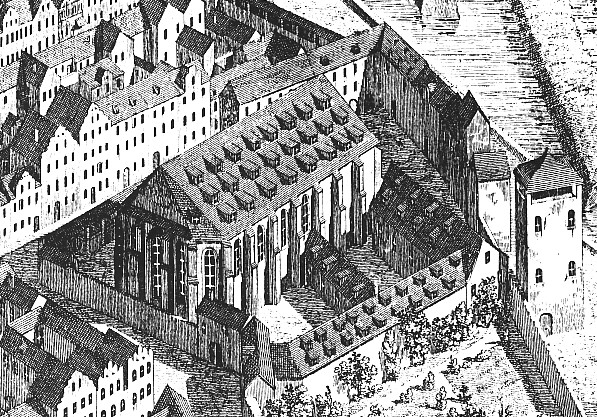 Klosterkiche and monastery around 1550
Around 1541, in the time of the Reformation, the monastery was abolished and the Franciscans left the place. The building stood empty until it was reopened as a Lutheran church by Sophie of Brandenburg in 1610. In the following century, the Sophienkirche also became the city's Evangelical court church (Evangelische Hofkirche). Another change around the same time was the installation of a Silbermann pipe organ between 1718 and 1720, in which Bach probably performed (It shoud be noted that his son Wilhelm Friedemann was organist in the church from 1733).

Starting from 1864, the church configuration was modified - the baroque side tower was replaced by two neogothic spires and aisles were also added, although the Gothic nave from 1331 and the Busmannkapelle from the early 15th century remained with only minor modifications. The last prewar change were the copper-covered spires that from 1932-3 replaced the neogothic ones, which by that time were neglected because of the weather.
 Before 1864
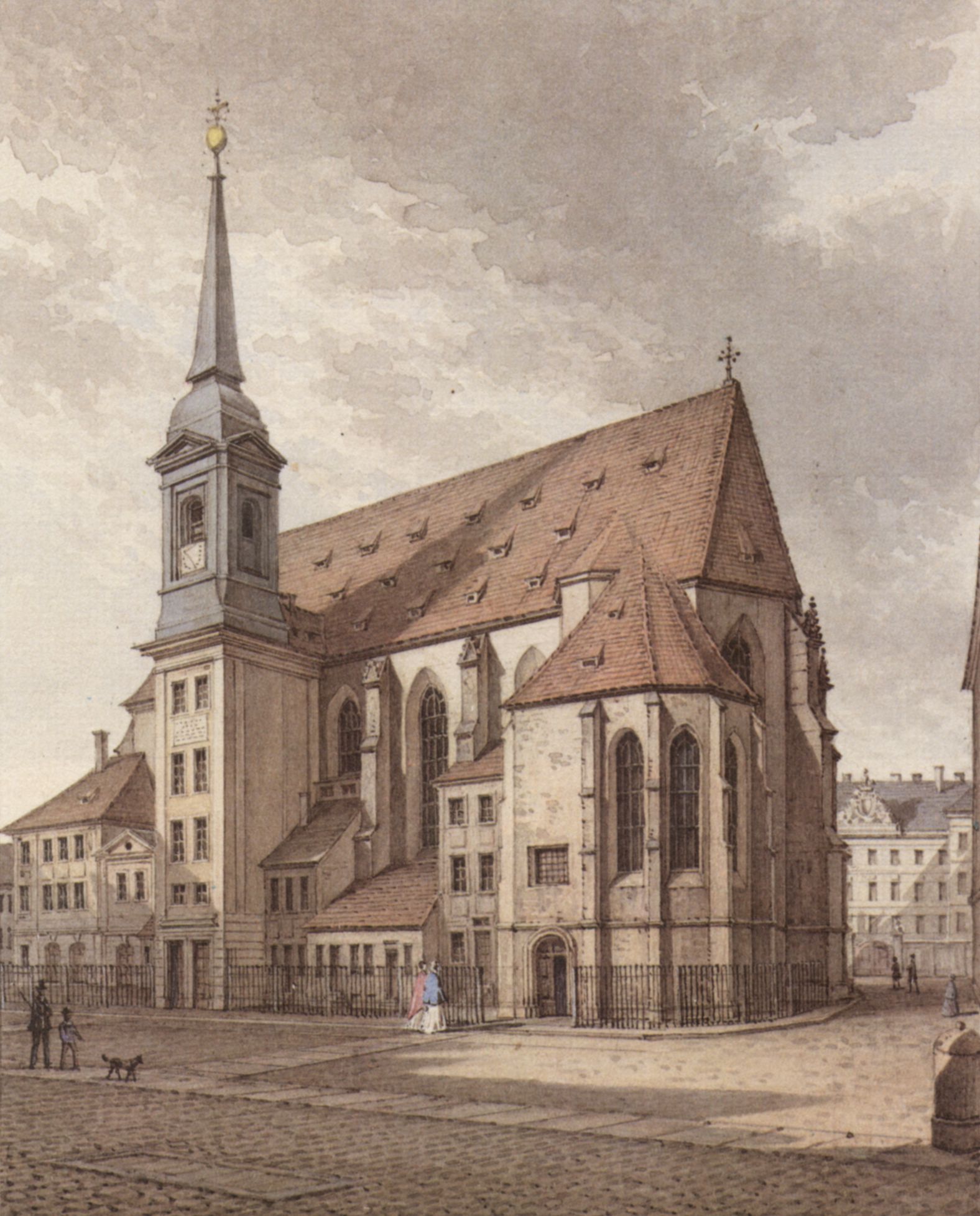 Before 1864
 Around 1890
 After 1933
Although the church, like most of Dresden, was gutted by fire as a consequence of the devastating air raids of 13-15 February 1945, the main structure remained in a relative good condition (see this photo from 1960). Some elements, like the Nosseni and Sacristy Altars were salvaged, before the ruins of the oldest church in Dresden were blown up in 1962 under SED decree. The party chief Walter Ulbricht had commented before, "A Socialist city does not need Gothic churches!".
Starting from 2009, a memorial has been under construction. Resembling the Busmannkapelle, it's scheduled to be finished this year, although no project for the church as a whole has been planned yet.
Starting from 2009, a memorial has been under construction. Resembling the Busmannkapelle, it's scheduled to be finished this year, although no project for the church as a whole has been planned yet.
Other buildings like the Altstädtische Hauptwache were spared from total destruction. This structure was built by Joseph Thürmer following plans by Schinkel in 1830-32 as a guardhouse for the Royal Castle, located just across the street. After WW2, the city government decided to keep and restore the outer walls, although a new, modernist interior was built.
Last in this post, but not less important, is the Monument to King John of Saxony. Located in the center of the Theaterplatz, this memorial consists in a equestrian statue cast by Johannes Schilling in 1889.
Monday, February 14, 2011
Berliner Stammstrecke, Busmannkapelle

109 years ago, the first line of the Berlin metro (Untergrundbahn, U-Bahn for short), was inaugurated by Kaiser Wilhelm II. This first line (known as the Stammstrecke), now part of the U1 and U2, ran from Stralauer Tor (in the eastern end of the Oberbaumbrücke) to Zoologischer Garten, and served 12 stations: Stralauer Tor, Schlesisches Tor, Oranienstraße (today Görlitzer Bahnhof), Cotbusser Thor, Prinzenstraße, Hallesches Tor, Möckernbrücke, Gleisdreieck, Bülowstraße, Nollendorfplatz, Wittenbergplatz and finally, Zoologischer Garten, in addition, a short track ran from Gleisdreieck to Posdamer Platz. In the same year, the service was extended eastwards to Warschauer Brücke (today Warschauer Straße), and Knie.
 Viaduct under construction: Wassertorplatz, between Prinzenstraße and Cottbuser Thor
 Early on this day, I uploaded to the Warehouse two of these stations, which had different fates: Stralauer Tor and Nollendorfplatz.
 U-Bahnhof Stralauer Tor, 1902
Stralauer Tor, located in the eastern end of the Oberbaum bridge in Friedrichshain, received its name after the historical city gate of the Berlin customs wall (Akzisemauer), located in the same spot. The station served as the U1 terminus until the completion of Warschauer Brücke, later that year. Stralauer Tor was renamed Osthafen in 1924, and continued to serve using that name until WW2. In March 1945, the elevated station was heavily damaged by Allied bombing. The Communist authorities decided not to rebuild U-Bhf. Osthafen because of its close proximity to the boundary between Sovied and American occupation sectors (i.e. East and West Berlin).
Named after the village of Naklérov in today Czech Republic (site for the 1813 battle of Kulm), U-Bahnhof Nollendorfplatz is located in the square of the same name in Berlin-Schöneberg. It was subject to many modifications - the eastern entrance hall was modified in the interwar years, first in 1923 and later in 1926/27. The structure from 1927 is the only part that remained until our days.

Again, Allied bombing left the station unsuitable for service (the eastern end of the elevated building had collapsed). Damage was partly repaired and by the early 1950s the station was back in service. However, the remains of the old building were demolished, and the current new structure was built. By the same time, the square, lost its old shape. On 1999 a simplified dome was added to the building, but unlike the original dome, it is just an ornament.
Other stations had a different fate. U-Bahnhöfe Oranienstraße and Warschauer Straße are almost in their original condition; U-Bahnhöfe Wittenbergplatz and Schlesisches Tor survived the war intact; U-Bhf. Bülowstraße was enlarged in 1929; the stations Cottbusser Thor and Möckernbrücke were demolished and rebuilt in the 20s and 30s, the former 170m westwards as a two-level station, and the latter had a new structure built because of increased number of passengers; Hallesches Tor and Prinzenstraße survived with postwar modifications.
At the same time, on a totally different context, I uploaded the model of the Busmannkapelle in Dresden. The Sophienkirche, Dresden oldest church, was originally part of the Franciscan monastery (Dresdner Franziskanerkloster), that was demolished around 1330 for the construction of a new, Gothic church.
At the same time, on a totally different context, I uploaded the model of the Busmannkapelle in Dresden. The Sophienkirche, Dresden oldest church, was originally part of the Franciscan monastery (Dresdner Franziskanerkloster), that was demolished around 1330 for the construction of a new, Gothic church.

As we all know, the Busmannkapelle, along with the Sophienkirche and the Dresden city center burned after the devastating air raid carried out by Allied forces in the nights of February 13th and 14th. This is an excerpt from a letter written by American ssoldier Kurt Vonnegut, who had been captured the year before, and was imprisoned in a underground slaughterhouse in Dresden by the time of the attack.
On about February 14th the Americans came over, followed by the RAF, their combined labors killed over 250.000 people in twenty four hours and destroyed all of Dresden - possibly the world's most beautiful city.

The Sophienkirche was gutted by the resulting inferno. However, the structure remained standing and a restoration could have been possible. Sadly, the ceiling and part of the the northern tower collapsed in 1948 as a result of the damage. Its fate was uncertain until 1950, when the SED party chief Walter Ubricht commented that "a socialist city doesn't need gothic church towers", dooming the church. Despite the protests by architects and overall population, the Sophienkirche remains were blown up in 1962.
I hope to make an extended post about the Sophienkirche later. I'm currently making the 3D, but I need more color pictures.
Subscribe to:
Posts (Atom)