Monday, September 27, 2010

Charlottenhof.

Today I have uploaded to the Warehouse another model located on Sanssouci Park: Schloss Charlottenhof.

Charlottenhof was built between 1826 and 1829 by Prussian architect Karl Friedrich Schinkel with the help of his student Ludwig Persius, by order of Crown Prince Friedrich Wilhelm (later Friedrich Wilhelm IV of Prussia, "the Romantic in the Throne"); the Kronprinz had created some designs for the project. The Palace is located on the site of a former farm house, and was built as a neoclassical villa for the Crown Prince, who used it as his summer residence.

View in Google Earth

The furniture inside the palace was largely designed by Schinkel himself. The most dinstictive room is fashioned after a Roman Caesar's tent, decorated with blue and white patterns.

Stained glass in Charlottenhof - detail

The Palace is maintained by the Prussian Palaces and Gardens Foundation Berlin-Brandenburg.

Friday, September 10, 2010

Well, this post is a request to the Berliners (and maybe a clue for what I'm doing now). I need a clear picture of the façade of the Hotel Esplanade in Bellevuestraße (the preserved one, behind the glass), with reflection as least as possible. Could someone please take some photos? You may upload the images to your favorite host-site (Imageshack, Photobucket, Flickr, etc) and post the link here as a comment. Thank you.

Wednesday, September 8, 2010

Coming surprise

You may want to know why I have not uploaded more models to the Warehouse recently. Well, I'm a little busy this last month. I have a surprise, but, I must say, you have to wait.

PD. Does anyone has a photo showing the entire Alte Postdamer Strasse façade of the Weinhaus Rheingold?

Monday, August 30, 2010

And finally, I found it.

I still had the picture of the Justizpalast on my mind. I wanted to do it.
I was searching in the web, and decided to look at an article about one of the search results, "JVA Moabit". I got the coordinates and went to Google Earth. I saw this:
And, using archive from 1943/45 and then 1953.

In the first picture, Justizpalast would have been located in the lower right, southeast from the star-shaped building. The facility in the upper left is the Kriminalgericht Moabit, built between 1902 and 1906. In the second, you can see the Justizpalast as seen from a US aircraft in 1943/45 (the pictures are combined in the 1945 archive), before the respective bombings, and 1953. Although the quality in the 1943 photo is not good, you can notice both the Justizpalast and the star-shaped facility. In the picture from 1945 (upper right), you can see a slighty bomb-damaged building.
In the 1953 photograph, you can see the empty space where the Justizpalast once stood. The star-shaped building survived both bombings.
I must say that the 3d building size may not be accurate, however, I have tried to keep the building in the right proportions.


Sunday, August 8, 2010

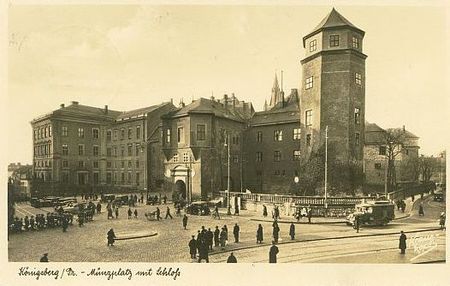
Königsberg Castle

Place of coronation of two Prussian Kings (Frederick I as King in Prussia and Wilhelm I, future German Emperor), by 1861 the Königsberg Castle was more than the walls and towers of the once Teutonic fortress. When Wilhelm I was coronated, the castle had incorporated the old defensive walls dating back from the Teutonic period (15th century), the Brick Gothic church (Schlosskirche) from 1594, the "Blood Court" (Blutgericht), a wine cellar built in the late 14th century, and some recent structures from the 18th and 19th centuries.

Konigsberg Castle: Brick gothic church and tower (middle), Blutgericht (right)

The Haberturm was the oldest tower (built ca. 1255) of the castle. It was the northeastern tower of the Schloss and a distinctive part of it, being visible from the other bank of the Schlossteich (Castle pond).

The castle contained also the Prussian Collection, with exhibits from the Prussian State Library and many art works.

All of this burnt down after the savage attack carried out by RAF in August 1944 - more than 800 airplanes bombed the city centre. Minor bombings by the Soviet air force, and later the Battle of Königsberg further damaged the castle. After the war, the Altstadt was no more than some destroyed buildings, the Königsberger Schloss and the shell of the Cathedral.

Königsberger Dom (Cathedral) as seen from the ruined Castle, 1949.

Despite all, the Castle walls remained standing. The end definetely came in 1968, when USSR leader Leonid Brezhnev decided to delete any sign of German past. The Schloss survived the first blast, - as a last showing of defiance to the Reds - that only torn down the brick gothic tower. A second explosion erased from Earth the remaining parts of this jewel (called "a symbol of Prussian fascism" by the Soviets, as other palaces like the Stadtschlösser in Berlin and Potsdam. The same they said, the same they did).

I have tried to make it the most accurate as possible, using a ground plan of the castle. The geometry work was the easy part - texturizing it was the difficult one. Although I could find many photos of the east, south and western parts, and three photocromes (Südseite, Ostseite and courtyard), I did not found pre-war photos of the northern side, for them I reviewed pictures displaying the ruined building.

Hope you like it.


Thursday, July 29, 2010

The 'Mosque' on the Havelbucht

Until the early 1840s, the fountains on Sanssouci Park couldn't receive water from the reservoir Frederick II designated for them. In 1942 an engine built by businessman August Borsig (the original owner of the Palais Borsig in Berlin) was used to rise the water on the Great Fountain to a height of ca. 38 m. The then Prussian King, Friedrich Wilhelm IV, ordered the construction of this pumping station. Built by architect Ludwig Persius, the "Pumpenhaus" was designed with the shape of a Turquish mosque.

Saturday, July 10, 2010

Two days ago Google uploaded this video showing Stuttgart and Berlin, the capital cities of Baden-Würtenberg and Berlin/Germany respectively, in 3D. There you can see some of my models, like the Staatsoper, St. Hedwig's, the Kanzleramt, Zeughaus, Gendarmenmarkt (excepting the French Cathedral), Soviet War Memorial in Tiergarten, etc. Along wih them, there are more very good models like the Reichstag, "Kommode" and Branderburger Tor by Emperor Heer, Kongresshale by Michael Riese, and JWagner's Tempelhof Airport.


Also, and although I personally dislike BM models, I must say that I have seen excellent online-modeled buildings. Some examples are the Hotel am Hauptbahnhof, the North Korean Embassy on Kaiserhofstrasse, Schinkel's Bauakademie and the Bahnhof am Alexanderplatz.

Tuesday, June 29, 2010

From Berlin to Potsdam

Two days ago, I uploaded three new models to the Warehouse. Three palaces located in Sanssouci Park.

The first one is, obviously, Schloss Sanssouci.

Easily one of the most famous palaces in Germany, Sanssouci is the former summer palace of Prussian king Frederick II, "the Great". The palace was designed by Wenzeslaus von Knobelsdorff following plans of Frederick himself, as a private residence for the King. The palace was built between 1745 and 1747 in the so-called "Frederician Rococo".

The palace remained as a residence of the Hohenzollern Family until Wilhelm II abtidation. From then and although the building was still property of the former Imperial family, it was no longer used as a palace.

After WWII Sanssouci became mantained by the East German government, as a tourist attraction. Following German reunification, the body of King Frederick II was returned to Sanssouci, and buried in a new tomb.


The New Palace in Potsdam (Gr. Neues Palais) was built under the rule of Frederick II, King of Prussia, to conmemorate the end of the Seven Years' War. The palace was built in a baroque style, and was intended to demonstrate the glory and power of the Kingdom of Prussia after tthe war. After his death, the palace fell in disuse until 1859, when it became the summer residence of Crown Prince Friedrich Wilhelm, later Kaiser Friedrich III. The palace was restored under the rule of Kaiser Wilhelm II.

After German Revolution, the palace was used as a museum.


The Orangery Palace was built between 1851 and 1854 in Sanssouci Park, Potsdam, by Friedrich August Stüler, a student of Schinkel, and L.F. Hesse according to drawings by King Friedrich Wilhelm IV.


These models are only part of a group of models I will make. The group will include:

  • New Chambers
  • Bildergalerie
  • Belvedere
  • The Communs near Neues Palais
  • Antique Temple
  • Temple of Friedship
  • Historical Windmill
  • Potsdamer Stadtschloss
  • Nikolaikirche, Potsdam
  • And finally, maybe, Schloss Charlottenhof and the Roman Baths.

Saturday, June 19, 2010

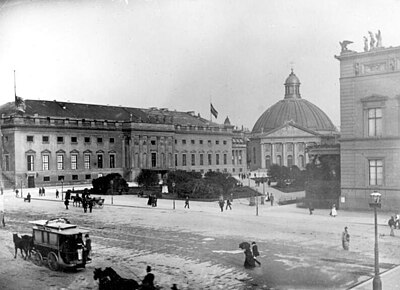
Opernplatz

This square was laid out between 1741 and 1743, under the rule of King (König) Frederick the Great. The buildings surrounding it were largely destroyed by the Allied air raids over Berlin, and were rebuilt in the 1950s.

To the left of the picture is the Berlin State Opera (Berliner Staatsoper), first built between 1741 and 1742, and reconstructed in 1843, after a fire destoyed it. Almost 100 years later, the Allies would cause heavy damage to the building in two air raids, first in 1941 (the Staatsoper was repaired and reopened the following winter) and then in February 1945. The Opera House reopened ten years later.


At the center of the picture, you can see the St.-Hedwigs-Kathedrale.

To tle right can be seen part of Berlin Royal Library and Altes Palais.

The Berlin Royal Library (model by Emperor Heer 99) was built between 1775 and 1780 by architect Georg Christian Unger, after a design by Joseph Fischer von Erlach. After the construction of the nearby Berlin Staatsbibliothek (Unter den Linden 8). It's now part of Humboldt University.


Altes Bibliothek, Opernplatz by Emperor Heer 99.
The Altes Palais was built between 1834 and 1837 as a palace for the then Prussian prince and future Kaiser, Wilhelm, in a Neoclassical style following plans of C.F. Langhans. After Kaiser Wilhelm's death, the palace opened as a memorial. The palace continued to be property of the House of Hohenzollern after Wilhelm II abdication in 1919.
The Palais resulted damaged after the Allied bombing of Berlin, and was reconstructed first in 1963-64 and then between 2003 and 2005. Now it is used by the Humboldt University.

Friday, June 11, 2010

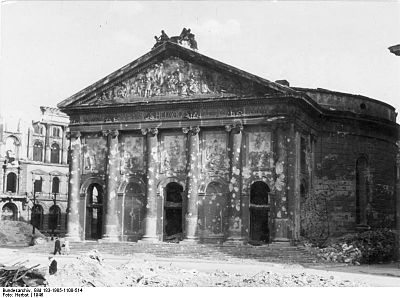
St. Hedwig's Cathedral

In 1747, the construction of the first post-reformation Roman Catholic church in Berlin began, under permission of King Friedrich II. The King of Prussia wanted to give a place of worship to Catholic inmigrants that arrived to Berlin. The construction was finished in 1773.

In November 1943, an Allied air raid caused a fire on the Cathedral. 

The building was repaired between 1952 and 1963, although the lantern that once stood in the upper part of the dome was not rebuilt.