
Saturday, May 30, 2020

Tuesday, February 25, 2020
Ladies and gentlemen, I want to let you all know that I will no longer make any uploads to the 3D Warehouse, since the changes in terms and conditions as set by Trimble - they require me to accept in order for me to access it, despite me having had a preexisting account - and the fact that some of my models have been either deleted or hidden from public view - as you can see scrolling down the blog.
Thus, unless otherwise stated on this same platform (i. e. my blog), all updates and pictures of new models will be published here, along with material from those models made unavailable by Trimble.
I'll see you soon.
Sunday, February 23, 2020

Wednesday, February 6, 2019

Saturday, June 14, 2014
New: Hamburg Cathedral
After a long absence, I've decided to present my latest model that has its setting in Germany. Now that Google has effectlibly baanned new models from the Google Earth 3D layer, I've been spending my time in reconstructions. This one was especially difficult, since the structure it attempts to resemble was demolished long before any photos of it could be taken.

Hamburg Cathedral was originally built as a wooden chapel in the 9th century, soon after it became the seat of the joint Diocese of Hamburg and Bremen. In the elenventh century, Archbishop Adalbrant ordered the construction of a new brick cathedral along his castle. Construction of a third, Brick Gothic cathedral began under Gebhard, Prince Archbishop of Bremen. The new building was consecrated by Archbishop Burchard in 1329. By the mid 15th century, two naves and a tower had been added to the three nave church, and an additional hall was built in the early 16th century.

16th century annex to the cathedral (source)
The decadence of the cathedral started soon after the city's conversion to Lutheranism. It became isolated as a Catholic temple in a Protestant city, and even after it was reopened as a Lutheran parish, its situation as an enclave of the former Archbishopric, now Duchy of Bremen, made its administration difficult. After the Imperial Mediatisation of 1803, the Duchy ceded the former cathedral to the City of Hamburg. The Senate decided to demolish the structure soon after.

I'm posting screencaps by now. A KMZ file will be avaliable for download soon.


Side view


Overview
Monday, August 19, 2013
Schloss Herrenhausen

c. 1900
First built in the 17th century, Herrenhausen was conceived as a Baroque summer residence for the Princes of Lüneburg. The palace was developed on the grounds of a previous guest house. The building was enlarged in 1676 under Prince Johann Friedrich of Calenberg, and later under Ernest August I and George I Louis, who was in personal union Elector of Hanover and King of Great Britain.
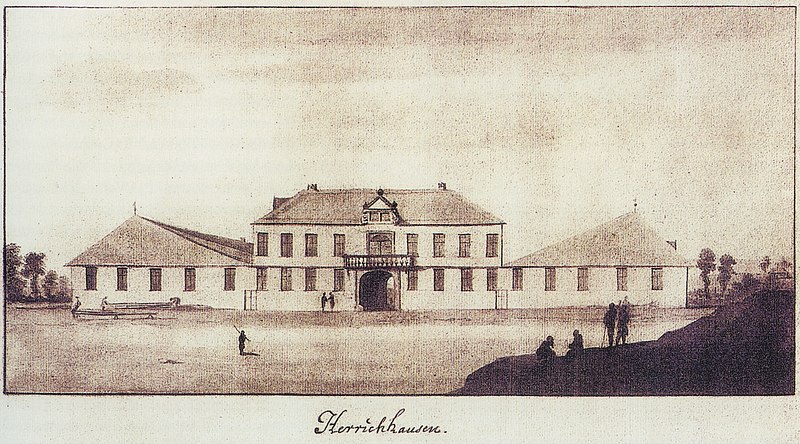

Herrenhausen in 1670 and 1764

George II of Great Britain, born in Herrenhausen Palace in 1683
The palace was rebuilt as a neoclassical residence by architect Georg Ludwig Laves in 1820 under the regency of the Crown Prince, later George IV. In addition to the palace, a large baroque garden had been developed on the course of decades, and was considered to one of the most beautiful in continental Europe.

Herrenhausen Palace and gardens c. 1880
On October 1943 Hannover was bombed by RAF. Incendiary bombs fell over the city, already damaged by another bombing nine days earlier. While several sections of Herrenhausen garden survived, including the pavillions and fountains, the palace itself was destroyed.

(source: Hannoversche Allgemeine Zeitung)
In 2007 the state government of Lower Saxony made public plans for its reconstruction. The former palace was rebuilt between 2011 and 2013, and was inaugurated by Lord Mayor Stephan Weil, Minister-President David McAllister, HRH Princess Beatrice of York, and HRH Princess Eugenie of York on 18 January 2013.
Thursday, February 7, 2013

Wednesday, February 15, 2012


Tuesday, February 14, 2012
Two more models are expected to be avaliable for Google Earth in the next days:
Let's start with U-Bhf. Hallesches Tor.
As with some other U-Bahn stations in Berlin, Hallesches Tor was named after a historical city gate, in this case, Hallesches Tor was the start of the road that led to the city of Halle upon the Saale, in present-day Saxony-Anhalt.
 Hallesches Tor around 1800
 During construction, 1902
 Hallesches Tor, c.1902
Let's start with U-Bhf. Hallesches Tor.
As with some other U-Bahn stations in Berlin, Hallesches Tor was named after a historical city gate, in this case, Hallesches Tor was the start of the road that led to the city of Halle upon the Saale, in present-day Saxony-Anhalt.
 Hallesches Tor around 1800
The station was built close to the former location of the gate, and opened in February 1902 as part of the Stammstrecke, first U-Bahn line.
 During construction, 1902
 Hallesches Tor, c.1902
The station was damaged by bombing during WW2, and had to be closed in April 1945. The structure was rebuilt in the following years.
The second model is an addition to Dresden cityscape, of course, I'm talking about the Taschenbergpalais.

This baroque palace was built by Johann Friedrich Karcher for Countess Anna Constanze of Hoym between 1705 and 1708. This structure stood there for over 230 years, before being heavily damaged by the Allied bombing that destroyed most of Dresden in February 1945. The ruins would remain there for the next 47 years, until the construction of the current structure, which serves as a Kempinski hotel since its completion in 1995.
 The Taschenbergpalais ruins in 1990
 The Taschenbergpalais ruins in 1990
And for anyone who hasn't noticed it yet, the Berliner Stadtschloss is avaliable for download as a KMZ file since January 17th, to conmemorate the creation of the Kingdom of Prussia and the proclamation of the German Empire in January 18th, 1701 and 1871, respectively. Enjoy!
Subscribe to:
Posts (Atom)